
Why Strong Market Positioning Is A Competitive Advantage For SMEs In 2026
Many SMEs are not struggling because they lack capability, expertise or good people.
They are struggling because potential customers cannot easily understand why they should choose them over competing alternatives.
As markets become more competitive, customers have more choice and more ability to compare providers than ever before.
As a result, many capable businesses struggle to stand out, attract the right customers and communicate the value they genuinely deliver.
In many cases, the problem isn’t the business itself.
It’s how that business is positioned.
Many SMEs don’t have a marketing problem.
They have a positioning problem.
The Short Answer
Many SMEs don’t lack expertise, capability or value.
They struggle because customers can’t easily see or understand what makes them different.
In many cases, the differentiators already exist. They are simply not being communicated clearly enough for customers to recognise their value.
Positioning helps bridge that gap by making a business’s strengths, relevance and value easier for the market to understand.
SME’s Positioning Problems In Summary
In this article we’ll explore:
- What positioning actually means in practical business terms
- The difference between positioning, targeting and differentiation
- Why many SMEs struggle to stand out despite delivering excellent products and services
- How positioning has become increasingly important in more competitive markets
- How strong positioning helps attract better-aligned customers and enquiries
- A practical framework for assessing and improving your positioning
We’ll also explore why many SMEs already possess genuine differentiators, but fail to communicate them clearly enough for customers to recognise their value.
The Positioning Challenge: Many Businesses Sound the Same
Spend half an hour reviewing websites in almost any industry and you’ll start seeing the same marketing positioning patterns.
- Quality service
- Experienced team
- Trusted experts
- Tailored solutions
- Customer-focused approach
- Locally owned and operated
None of these statements are inherently wrong.
The problem is that competitors are making the same positioning claims.
This is particularly common in industries such as:
- Professional Services
- Financial Services
- Manufacturing
- Engineering
- Business Consulting
- Construction
- Trades
When businesses communicate in broadly similar ways, customers struggle to understand what genuinely separates one provider from another.
As a result, businesses become increasingly difficult to distinguish, regardless of the quality of their work.
Why Good Businesses Get Overlooked
Many SMEs assume that if they consistently deliver good work, customers will naturally recognise the difference.
Unfortunately, markets rarely work that way.
Customers can only judge what they can see and understand.
If your expertise, strengths and value are not communicated clearly, much of that value remains invisible to potential customers.
This is one of the reasons highly capable businesses can struggle to grow while less capable competitors appear to gain greater attention.
The difference is not always performance.
Often it is perception.
And perception is heavily influenced by positioning.
This is also why positioning can be difficult to solve from inside the business. Owners and leadership teams naturally see the full depth of their capability, while customers only see the signals the business puts into the market.
An experienced Fractional CMO can help identify the gap between how the business sees itself and how it is likely to be perceived by potential customers.
What Is Market Positioning?
Positioning is how customers perceive your business relative to competing alternatives.
It shapes what people think about your expertise, relevance, credibility and value before they ever contact you.
When a prospect encounters your website, advertising, content, referral or sales material, they are subconsciously trying to answer a series of questions:
- What does this business actually do?
- Who is it best suited for?
- Why should I choose them instead of another provider?
- Do they understand my situation?
- Can I trust them?
Strong positioning helps answer those questions.
Weak positioning leaves customers uncertain and makes comparison easier.
Positioning, Targeting and Differentiation
Positioning is often confused with targeting and differentiation, but they are not the same thing.
| Concept | The Question It Answers |
| Targeting | Who are we trying to attract? |
| Positioning | How do we want to be perceived? |
| Differentiation | Why should customers choose us? |
For example, a financial advisory firm may target:
- Business owners
- Professionals
- Pre-retirees
- High-income households
That’s their target market.
However, they still need to decide how they want to be positioned within that market.
Do they want to be perceived as:
- the retirement planning specialist?
- the business owner’s adviser?
- the family wealth adviser?
- the premium personalised service provider?
- the low-cost investment manager?
Differentiation then provides the reasons customers should choose that business over available alternatives.
This distinction is important because many SME owners assume positioning means narrowing their audience.
In reality, positioning is less about who you can sell to and more about how you want customers to think about your business when they compare it to alternatives.
Why Positioning Matters More Than Ever For SMEs
Positioning has always mattered.
Today, it matters more.
Twenty years ago, being local, established, responsive or competitively priced was often enough to create meaningful distinction.
Today, customers have more choice, more information and more ability to compare suppliers than ever before.
At the same time, competitors often sound remarkably similar.
Many promise:
- Quality service
- Tailored solutions
- Industry expertise
- Customer-first support
- Reliable outcomes
Visibility alone is no longer enough.
The challenge is not getting noticed.
The challenge is communicating why your business is the right choice once it has been noticed.
In crowded markets, clarity has become a competitive advantage.
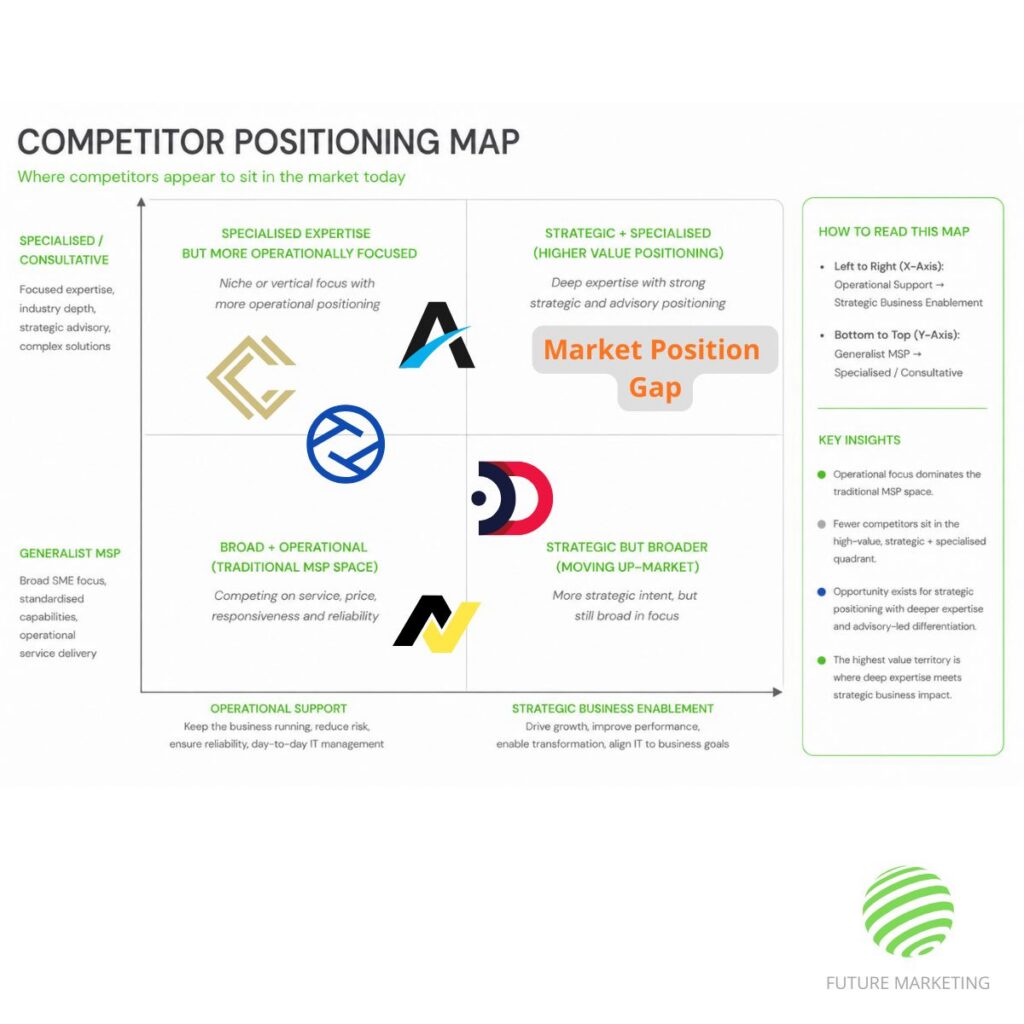
Market Positioning Shapes Perceived Value
Positioning does more than influence awareness.
It influences value.
Two businesses may offer remarkably similar products or services, yet be perceived very differently by the market.
One may be viewed as:
- A specialist
- An expert
- A trusted adviser
- A premium provider
While another may be viewed as:
- A generalist
- A supplier
- A transactional provider
- A commodity
The actual difference in capability may be relatively small.
The difference in perceived value can be significant.
This perception influences:
- Customer trust
- Conversion rates
- Pricing power
- Referral potential
- Customer loyalty
Positioning therefore affects far more than marketing performance.
It influences how customers evaluate the value of the business itself.
Most SMEs Already Have Valuable Differentiators
One of the biggest misconceptions surrounding positioning is the belief that businesses must discover a completely unique selling proposition in order to stand out.
In reality, positioning is rarely about inventing something entirely new.
More often, it involves identifying strengths that already exist within the business and communicating them more clearly and more consistently than competitors.
Many SMEs already possess valuable differentiators.
These may include:
- Deep industry expertise
- Faster response times
- Better communication
- Specialist knowledge
- Stronger customer relationships
- Greater flexibility
- Higher service levels
- Better project management
- More practical experience
The problem is rarely that these strengths do not exist.
The problem is that they are often not clearly communicated.
The more difficult task is determining which strengths are genuinely distinctive, which matter most to customers and which are simply expected within the category.
This often requires more than an internal brainstorming exercise. Customer feedback, sales conversations, competitor analysis and commercial performance can all help reveal which attributes are most valuable to build the business’s positioning around.
In many cases, competitors are not winning because they are better.
They are winning because they communicate their value more clearly.
Positioning Sits At The Intersection Of Three Things
Strong positioning is rarely invented.
More often, it is discovered.
It emerges where three factors overlap:
1. What Your Business Does Particularly Well
Every business has strengths.
These may include technical expertise, customer service, responsiveness, communication, innovation or industry knowledge.
2. What Customers Actually Value
Not every strength matters equally to customers.
The strongest positioning focuses on attributes that influence buying decisions, solve meaningful problems and create confidence.
3. What Competitors Fail To Communicate Effectively
Positioning becomes more powerful when it highlights areas competitors overlook, under-emphasise or communicate poorly.
The goal is not necessarily to be unique.
The goal is to be distinctive and relevant.
Strong positioning is rarely discovered by looking inward alone.
It emerges when a business understands:
- What it does particularly well
- What customers genuinely value
- How competitors are currently positioned within the market
The overlap between these areas often reveals the most compelling positioning opportunities.
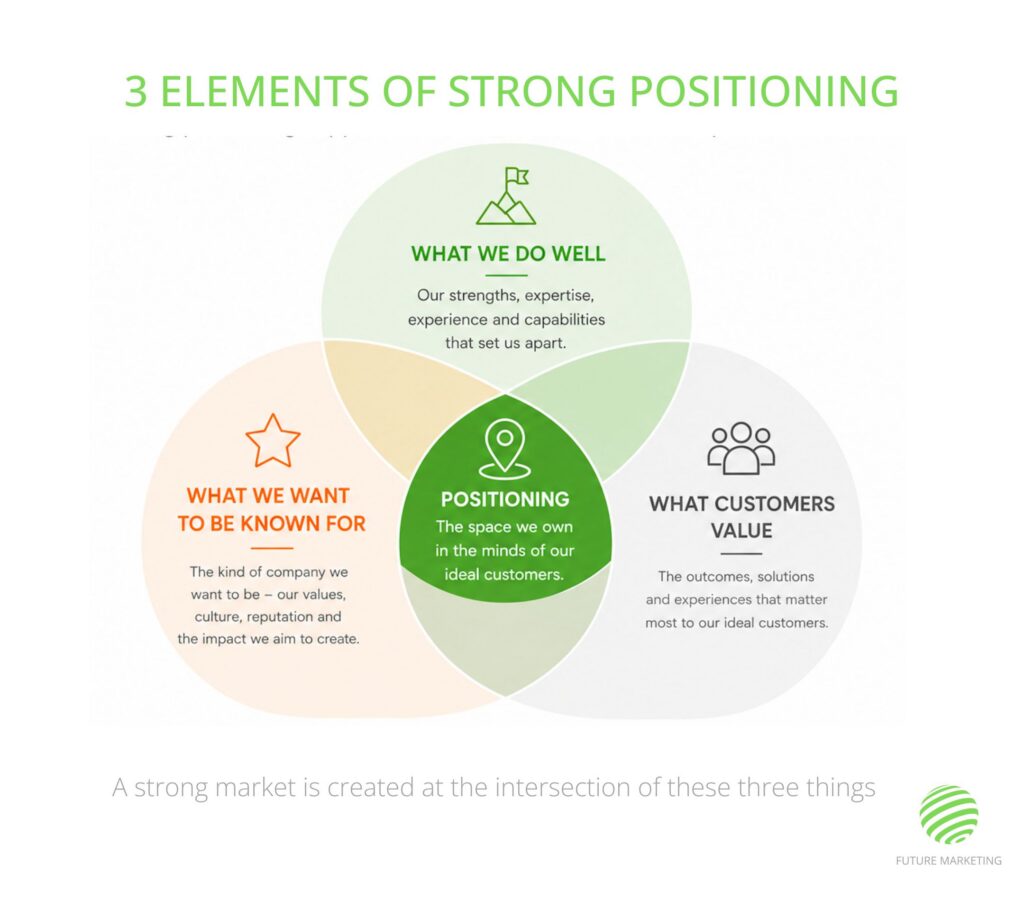
The goal is to be distinctive and relevant.
Strong positioning is rarely discovered by looking inward alone.
This is where external strategic marketing input can be particularly valuable.
A Fractional CMO can help an SME assess each part of this intersection objectively: what the business can credibly own, what customers actually care about and where competitors are leaving space for a more relevant position.
It emerges when a business understands:
- What it does particularly well
- What customers genuinely value
- How competitors are currently positioned within the market
The overlap between these areas often reveals the strongest positioning opportunities.
However, an opportunity is only worth pursuing when it is credible, commercially viable and aligned with the direction of the business. A Fractional CMO can help evaluate those trade-offs and distinguish an attractive idea from a position the business can realistically build and sustain.
Positioning Helps The Right Customers Self-Select
One of the most overlooked benefits of strong positioning is its ability to attract better-aligned customers.
Many businesses focus exclusively on generating more enquiries.
However, enquiry volume is only part of the equation.
The quality and relevance of those enquiries matters just as much.
When positioning is unclear, businesses often attract:
- Highly price-sensitive buyers
- Poor-fit customers
- Projects outside their area of expertise
- Customers with unrealistic expectations
Clear positioning helps potential customers quickly understand:
- Whether the business is right for them
- What type of work the business excels at
- How the business approaches problems
- What experience they can expect
As a result, stronger positioning often leads to:
- Better aligned enquiries
- Higher quality leads
- Improved conversion rates
- Stronger customer relationships
- Reduced price sensitivity
- More efficient marketing performance
This often leads to fewer enquiries, but better enquiries.
For many SMEs, that is a far more valuable outcome.
Better aligned customers typically create:
- Smoother projects
- Stronger relationships
- Higher retention
- Better referrals
- Greater long-term profitability
Market Positioning Is Not The Same As Niching
One of the biggest misconceptions about positioning is that it requires businesses to dramatically narrow their audience.
In reality, effective positioning is often about increasing relevance rather than reducing opportunity.
A manufacturing business can still serve multiple industries.
A financial adviser can still support different customer groups.
A construction company can still undertake different project types.
The goal is not to artificially restrict opportunities.
The goal is to provide clarity around where the business delivers the greatest value and why customers should choose it over alternatives.
Positioning is not about exclusion.
It is about relevance.
Four Questions Every SME Should Be Able To Answer To Help Find Their Market Positioning
If you were asked these questions in a strategy workshop, could your leadership team answer them consistently?
Many businesses discover that different team members provide different answers.
An external facilitator can help bring these competing views together, challenge assumptions and test internal beliefs against customer and market evidence.
For SMEs without a senior marketing leader in-house, this is one of the roles a Fractional CMO can perform: helping the leadership team move from several internal opinions to one clear and commercially grounded market position.
That inconsistency is often a sign that positioning requires further clarification.
1. Who Are We Best Suited To Help?
2. What Problems Do We Solve Better Than Competitors?
3. What Do Customers Value Most About Working With Us?
4. Why Should A Prospect Choose Us Over Available Alternatives?
Businesses that can answer these questions clearly typically find it much easier to communicate their value, attract the right customers and build more effective marketing campaigns.
Why Positioning Is a Competitive Advantage – Summary
Many SMEs respond to disappointing marketing results by increasing activity.
More advertising.
More content.
More channels.
More spend.
Sometimes the answer is not more marketing.
Sometimes the answer is greater clarity.
Creating that clarity requires more than rewriting the website.
It means making informed choices about the customers the business is best placed to serve, the value it should lead with and the position it has the capability and credibility to occupy.
For SMEs without that strategic marketing capability internally, a Fractional CMO can help work through those decisions before more money is committed to campaigns, channels and content.
Most SMEs do not need to reinvent themselves.
They need to become clearer about who they are, who they help and why customers should choose them.
Before investing in more marketing activity, it is often worth asking a simpler question:
Does the market truly understand the value that already exists within the business?
In increasingly competitive markets, clarity is one of the most valuable competitive advantages a business can build.
Need Help Positioning Your Business To Attract The Right Customers?
Future Marketing runs marketing and positioning strategy workshops for SMEs to help you clarify who your business is best placed to serve, what makes it valuable and how to communicate that more effectively.
To make an enquiry about a marketing strategy workshop, complete the contact form below.
Contact
"*" indicates required fields