
How Much Should An SME Marketing Budget Be? A Practical Perspective To Marketing Budget Setting For SMEs
One of the most common questions I hear from business owners is:
“How much should we actually be spending on marketing?”
It’s a fair question, and on the surface, it feels like it should have a straightforward answer. A percentage, a benchmark, something you can apply and move on.
In reality, most business owners already sense that it’s not that simple.
They know their business is different. Their market is different. Their growth ambitions are different.
And yet, without a clear way to approach it, many still fall back on familiar guidelines: 5% of revenue, 10% if growth is a priority, or something in that range.
Not because those numbers are necessarily right — but because they provide a starting point when setting a marketing budget or creating a marketing budget.
In this article, we’ll take a more practical look at how marketing budgets should be approached, what actually influences them, why simple benchmarks can fall short, and what needs to be considered before settling on a number.
Why Creating A Marketing Budget Is Not That Straightforward
Marketing budgets don’t exist in isolation.
They’re shaped by a number of underlying factors, such as:
- What the business is trying to achieve.
- How customers behave.
- The level of competition in the market.
- How different types of marketing activity contribute to growth.
Two businesses with similar revenue can require very different levels of investment depending on these variables.
Without that context, any percentage or benchmark becomes less of a strategy and more of a placeholder.
This is where many businesses struggle with calculating marketing budget requirements accurately, often defaulting to what feels standard rather than what is strategically required.
Not All Marketing Does the Same Job
Part of the complexity comes from the fact that not all marketing activity is designed to do the same job.
Some channels are there to generate enquiries directly – capturing existing demand from people who are already looking.
Others play a role earlier in the process – building awareness, shaping perception, and helping potential customers become familiar with your business over time.
Some activity is highly visible in reporting and delivers immediate feedback. Other activity is less direct, and its impact is often felt over a longer period.
All of these contribute to growth – but in different ways.
Which means budgeting isn’t just about deciding how much to spend, but also understanding marketing spend by channel and how different types of activity work together.
What Tends to Happen With Marketing Budgets in Practice
In most businesses, marketing budgets tend to evolve based on what feels like it’s working.
Channels that generate enquiries quickly – particularly those where results are easy to track – naturally attract more attention and investment.
Over time, this often leads to a heavier reliance on a small number of channels, while others are reduced or removed.
On the surface, this makes sense. It’s a logical response to what the data appears to show.
But over a longer period, it can create a more subtle challenge.
As more budget is concentrated into the same channels, costs can begin to rise. Competition increases, audiences become saturated, and the cost of generating each new lead gradually creeps up.
At the same time, the broader activity that supports these channels – building awareness, trust, and familiarity – may receive less focus.
This isn’t always immediately obvious, but it can show up in different ways:
- Fewer people searching for your business by name
- Lower engagement when users land on your website
- Conversion rates becoming harder to maintain
- A growing sense that more spend is needed just to achieve the same results
What’s happening here isn’t necessarily a problem with the channels themselves, it’s often a reflection of how the overall marketing budget allocation has evolved over time.
Start With the Business, Not the Marketing Budget
Before settling on a marketing budget, it’s important to step back and look at the bigger picture.
At a fundamental level, marketing exists to support the goals of the business – whether that’s growth, stability, expansion into new markets, or something more specific.
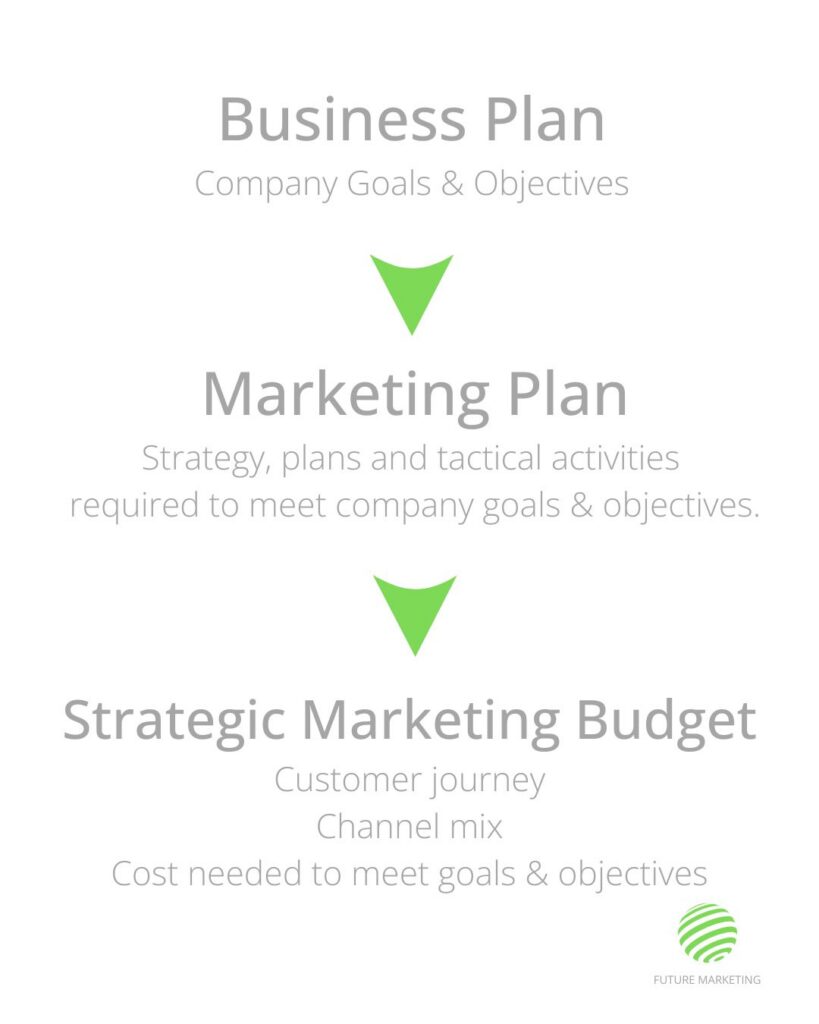
That means the marketing plan should be shaped by the business plan. And in turn, the marketing budget should be shaped by both.
When this sequence is clear, budgeting becomes a more structured exercise and supports a stronger marketing budget strategy.
When it isn’t, it often leads to choosing a number first — and then trying to make the strategy fit around it.
A marketing budget shouldn’t be decided in isolation.
It should be the result of what the business is trying to achieve, and what it will realistically take to get there.
What Needs to Be Considered Before Setting a Marketing Budget
To arrive at a marketing budget that makes sense, there are a number of factors that need to be considered – not in isolation, but as part of a bigger picture.
This is where a more structured marketing budget process becomes valuable.
Business & Commercial Context
Start with the fundamentals.
What is the business actually trying to achieve?
- Growth targets
- Revenue goals
- Market expansion
- Lead volume requirements
Alongside this, the commercial model plays a key role.
- What is a customer worth?
- What margin is available?
- Is revenue one-off or recurring?
These factors determine what level of investment is both required and sustainable, forming the basis of any business marketing budget.
Market & Customer Dynamics
Understanding how customers find and choose your business is critical.
- What does the customer journey actually look like?
- Where do potential customers first become aware of you?
- What influences their decision-making along the way?
- Are all key touchpoints being covered – and which ones matter most
- Are they influenced over time?
- Is the decision quick, or more considered?
This shapes the type of marketing activity needed to support growth.
These factors shape not only what marketing activity is required, but also where it should be focused.
It’s also important to consider the level of competition.
- How active are others in your space?
- How visible are they?
- What are you competing on: price, brand, service, or expertise?
Taken together, these elements influence how and where you choose to compete in the market.
And those choices have a direct impact on cost.
Different channels, strategies, and levels of visibility require different levels of investment, which in turn affects how budget needs to be allocated.
In other words, where you choose to play and how strongly you choose to show up, will ultimately shape the level of investment required.
Practical & Operational Reality
Marketing doesn’t operate in isolation from the rest of the business.
Current performance provides an important reference point.
- What does it currently cost to generate a lead or sale?
- Are those costs increasing or stabilising?
Operational capacity also matters.
- Can the business handle increased demand?
- Is the sales process effective?
- Is delivery capacity in place?
Finally, time horizon plays a role.
- Are you focused on immediate results?
- Or building sustained growth over time?
Different timeframes require different types of investment, and influence how quickly results can be expected.
So, How Should An SME Marketing Budget Be?
There isn’t a single “correct” number when it comes to marketing budgets.
A more effective approach is to start with the outcome the business is aiming for, understand what will be required to support that outcome, and then align marketing activity accordingly.
From there, the level of investment becomes clearer.
Some elements will be measurable and immediate. Others will be less direct, but still important in supporting overall performance.
The key is recognising that marketing budgets are not just about how much you spend, but how well that investment is aligned to the goals of the business.
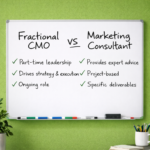
For many SMEs, this is where a fractional CMO adds the most value.
By bridging the gap between business strategy and marketing execution, a fractional CMO can help you define the right approach, prioritise the right activities, and build a marketing budget that is aligned, realistic, and commercially sound.
Need help figuring out your marketing budget?
No problem – that’s something I help SMEs with.
Get in touch by completing the form below and I will get back to you, usually within 24 hours.
Contact
"*" indicates required fields