Marketing has never offered businesses more opportunity — or more complexity. For many SMEs, the challenge is no longer access to marketing channels, but knowing which ones actually matter.
This article explores why many SMEs feel overwhelmed by modern marketing, why tactical activity often replaces strategic thinking, and how businesses can bring clarity back to their marketing decisions.
It outlines a simple framework for developing a focused marketing strategy and explains why strategic leadership, rather than more tactics, is often the missing piece.
Many SME owners believe their marketing problem is choosing the right channel.
– Should they invest more in SEO?
– Run Google Ads?
– Focus on LinkedIn?
– Start creating video content?
In reality, the problem is usually something else entirely. They don’t have a clear marketing strategy. Ten years ago, marketing for most SMEs was relatively straightforward.
A typical small business marketing strategy might have included:
-
a website
-
some SEO
-
Google Ads
-
perhaps a Facebook page
That was often enough to generate leads and support growth. Today, the marketing landscape looks very different. Business owners researching marketing strategy for their SME or small business are often told they should be thinking about:
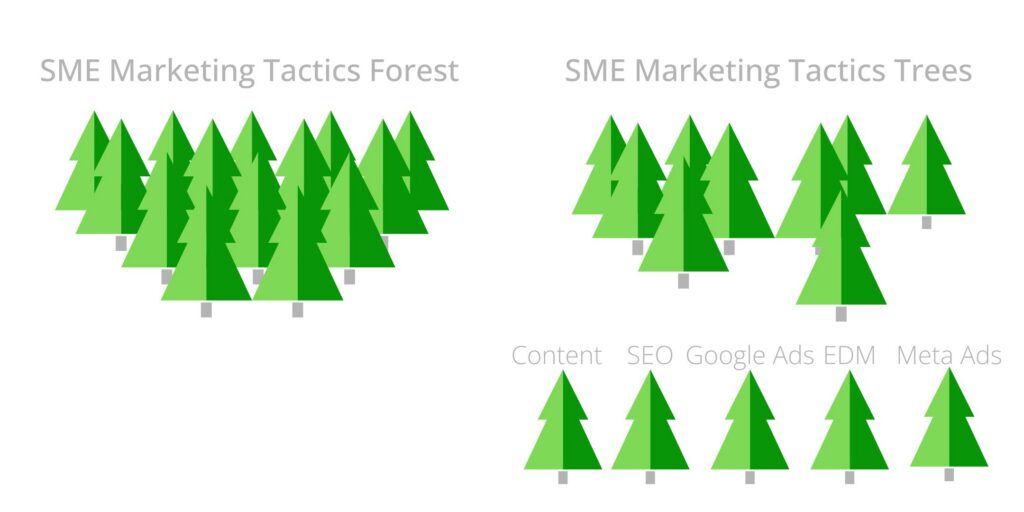
The options and ‘opportunities’ feel endless, even within digital niches (paid social for example). For many SME owners and growing businesses, it feels like standing in the middle of a forest of marketing options.
The problem isn’t a lack of opportunity.
It’s that there are too many options.
The Marketing “Forest” Problem
There’s an old saying about not being able to see the forest for the trees. In SME marketing today, the opposite is happening. Business owners are staring at the entire forest.
And it’s overwhelming.
What businesses actually need to focus on are a small number of strategic decisions that shape an effective marketing strategy:
Without these decisions, marketing activity quickly becomes reactive rather than strategic.
This is why many small and medium-sized businesses struggle to build a coherent marketing strategy, even when they are investing in multiple marketing activities.
The Rise of Tactical Marketing
Because the modern marketing landscape is so complex, many SMEs fall into what can be described as tactical marketing.
Marketing becomes a series of disconnected activities:
-
posting regularly on social media
-
running some Google Ads
-
sending occasional email newsletters
-
experimenting with new marketing platforms
Each tactic may make sense on its own.
But without an underlying business marketing strategy, results are often inconsistent.
Instead of strategy guiding marketing activity, tactics begin driving decisions.
The result is a fragmented approach where businesses try many things but struggle to build momentum.
Why This Happens So Often
There are several reasons why many SMEs struggle with marketing strategy.
The marketing landscape has expanded dramatically
There are now more marketing channels available to SMEs and growing businesses than ever before.
From SEO and paid search to LinkedIn, automation platforms and AI tools, the number of options has grown significantly.
Even experienced business owners can find it difficult to decide which marketing channels will deliver the best results.
Marketing advice is everywhere
Business owners are constantly exposed to marketing advice from many sources:
-
agencies
-
freelancers
-
LinkedIn posts
-
podcasts
-
YouTube
-
AI tools
Much of this advice focuses on specific tactics or platforms rather than helping businesses develop a clear strategic marketing plan.
Marketing specialists focus on individual channels
When SMEs do hire marketing help, it is often focused on one particular area:
-
an SEO specialist
-
a Google Ads contractor
-
a social media manager
Each specialist focuses on their channel.
But very rarely is someone responsible for the overall marketing strategy for the business.
What a Simple Marketing Strategy for an SME Looks Like
For many business owners, the phrase marketing strategy can feel abstract.
In reality, a simple SME marketing strategy often comes down to answering five key questions.
1. Target Market
Who are the specific customers or industries you want to attract?
2. Positioning
How do you want your business to be perceived compared with competitors?
3. Core Message
What problem do you solve, and why should customers choose you?
4. Channel Strategy
Which marketing channels will most effectively reach your target audience?
This might include SEO, Google Ads, LinkedIn, email marketing, or content marketing.
5. Measurement
How will you track results and understand whether your marketing investment is working?
Once these elements are clear, marketing activity becomes far more focused.
Instead of chasing every new platform or trend, SMEs can invest confidently in the channels that support their strategy.
In other words:
Strategy determines tactics — not the other way around.
When Strategic Marketing Leadership Becomes Important
For many SMEs, there comes a point where marketing needs strategic direction rather than more tactical activity.
This often happens when:
-
the business is growing but marketing lacks clear direction
-
multiple marketing channels exist but results are inconsistent
-
internal teams need clearer guidance
-
leadership wants better visibility of marketing performance
In these situations, businesses often benefit from working with a marketing strategy consultant or fractional CMO.
The role is not simply to run campaigns, but to ensure marketing activity is aligned with broader business goals.
The Bottom Line
The biggest marketing challenge for SMEs in 2026 isn’t a lack of marketing opportunities.
It’s the opposite.
There are more marketing channels, tools and platforms available to businesses than ever before. The companies that grow aren’t the ones trying to be everywhere. They’re the ones that step back, develop a clear business marketing strategy, and focus on the channels that matter most.
In a forest of marketing options, success often comes down to choosing the right few trees.